Steel pipes are integral components in various industries, used for transporting fluids, gases, and solids or for structural applications. Due to their strength, durability, and cost-effectiveness, steel pipes are widely used in sectors such as construction, manufacturing, oil and gas, and water supply systems. In this blog, we will delve deeper into the various types of steel pipes, their sizes, dimensions, and weight calculations, providing a comprehensive understanding of these vital components.
What is a Steel Pipe?
A steel pipe is a cylindrical tube made from steel, an alloy of iron and carbon. These pipes are hollow in nature, providing strength and resistance against high pressure, and are used in a range of applications such as transportation of liquids, gases, and solids, as well as for structural purposes. Steel pipes are highly versatile, durable, and resistant to extreme conditions, making them a preferred choice in many industries.
Steel pipes come in different grades, sizes, and manufacturing methods to cater to different demands. Whether used for plumbing, construction, or oil and gas pipelines, understanding the types, dimensions, and weights of steel pipes is essential when selecting the right pipe for your needs.
Types of Steel Pipes
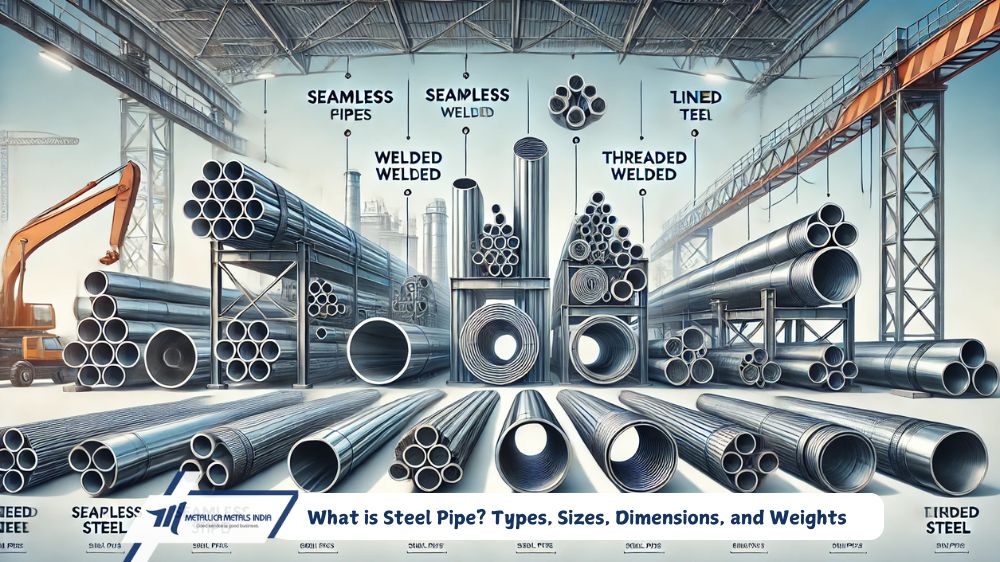
There are several different types of steel pipes, each designed for specific applications. Let’s explore the major types:
1. Seamless Steel Pipes
- Manufacturing Process: Seamless steel pipes are created by extruding solid steel billets and drilling them to create a hollow cylindrical tube. The process ensures the pipes do not have any welding seams, which enhances their strength and ability to withstand high-pressure applications.
- Advantages: Seamless pipes are more robust and reliable compared to welded pipes. They offer excellent resistance to high-pressure, high-temperature, and corrosive environments.
- Applications: These pipes are used in industries that require high strength and durability, such as oil and gas pipelines, power generation, automotive, and chemical industries.
2. Welded Steel Pipes
- Manufacturing Process: Welded pipes are made by forming a steel plate into a tube and welding the edges together. These pipes have a visible seam where the steel plates meet, which can be on the outside or inside of the pipe.
- Advantages: Welded pipes are generally less expensive to produce than seamless pipes. They are also easier to manufacture in larger diameters and lengths.
- Applications: Commonly used in structural applications, plumbing systems, HVAC systems, and low-pressure fluid transportation.
3. Spiral Welded Steel Pipes
- Manufacturing Process: These pipes are formed by welding steel plates into a cylindrical shape, but the weld seam runs in a spiral pattern rather than a straight line.
- Advantages: Spiral welded pipes are suitable for large diameters and long lengths. The spiral weld pattern allows for greater flexibility in handling and manufacturing.
- Applications: These are typically used for large-scale infrastructure projects, such as water and gas transportation systems, and oil pipelines.
4. Threaded Steel Pipes
- Manufacturing Process: Threaded steel pipes have threads at the ends of the pipe, allowing them to be easily connected with matching threaded fittings.
- Advantages: The ability to quickly assemble and disassemble the pipes makes them ideal for temporary setups or systems that require frequent maintenance.
- Applications: Used in low-pressure applications, plumbing systems, and water pipelines.
5. Lined Steel Pipes
- Manufacturing Process: These pipes have an internal lining of materials like plastic, ceramic, or rubber to prevent corrosion and increase durability.
- Advantages: Lined pipes offer enhanced protection against the transport of aggressive chemicals, high temperatures, or abrasive materials.
- Applications: Chemical plants, sewage systems, and food industry applications.
Steel Pipe Sizes and Dimensions
Steel pipes come in a wide variety of sizes and dimensions to cater to different applications. Understanding how pipe sizes are categorized is essential when selecting the correct pipe for your project.
1. Nominal Pipe Size (NPS)
Nominal Pipe Size is a standard designation used to define steel pipe sizes. It represents the approximate internal diameter of the pipe, expressed in inches. For example:
- An NPS 6 pipe typically refers to a pipe with an approximate internal diameter of 6 inches, though the actual internal diameter can vary slightly based on the pipe’s schedule.
2. Outer Diameter (OD)
The Outer Diameter refers to the total diameter of the pipe, including the wall thickness. While the NPS gives an approximation of the internal diameter, the OD is a precise measurement used to ensure compatibility with fittings and flanges.
3. Wall Thickness
The wall thickness is a crucial dimension of steel pipes, as it directly impacts the pipe’s strength, pressure capacity, and resistance to external damage. Pipe thickness is often specified by a schedule number, such as Schedule 40, Schedule 80, or Schedule 160. Higher schedule numbers indicate thicker walls.
4. Pipe Length
Steel pipes are generally available in standard lengths such as 20 feet (6 meters) or 40 feet (12 meters), but custom lengths can also be manufactured depending on project requirements.
Common Steel Pipe Dimensions and Schedules
| Nominal Pipe Size (NPS) | Outer Diameter (OD) | Wall Thickness (Schedule 40) | Wall Thickness (Schedule 80) |
|---|---|---|---|
| 1/2 inch | 0.840 inches | 0.109 inches | 0.147 inches |
| 1 inch | 1.315 inches | 0.140 inches | 0.179 inches |
| 2 inches | 2.375 inches | 0.154 inches | 0.218 inches |
| 4 inches | 4.500 inches | 0.237 inches | 0.337 inches |
| 6 inches | 6.625 inches | 0.280 inches | 0.432 inches |
| 8 inches | 8.625 inches | 0.322 inches | 0.500 inches |
Steel Pipe Weights
The weight of a steel pipe plays a significant role in handling, transportation, and structural capacity. Weights are determined by the pipe’s material density, dimensions, and wall thickness. Typically, the weight is calculated in kilograms per meter (kg/m).
Formula for Steel Pipe Weight
Steel pipes are usually weighed using the following formula:
Weight (kg) = (Outer Diameter – Wall Thickness) x Wall Thickness x Length x Density of Steel (7.85 kg/m³)
Example of Steel Pipe Weights (per meter)
| Nominal Pipe Size (NPS) | Schedule 40 Weight (kg/m) | Schedule 80 Weight (kg/m) |
|---|---|---|
| 1/2 inch | 0.569 | 0.791 |
| 1 inch | 1.018 | 1.361 |
| 2 inches | 2.271 | 3.039 |
| 4 inches | 5.658 | 7.937 |
| 6 inches | 8.916 | 13.474 |
| 8 inches | 13.174 | 20.706 |
Advantages of Steel Pipes
- Strength and Durability: Steel pipes are strong and can handle high pressure and temperature extremes. This makes them suitable for demanding applications in industries such as oil and gas and power plants.
- Corrosion Resistance: Steel, especially when coated, offers excellent resistance to corrosion. This is important in industries where the pipes are exposed to chemicals or extreme weather conditions.
- Cost-Effectiveness: Compared to materials like copper or aluminum, steel pipes are relatively affordable, especially for large-scale industrial projects.
- Flexibility: Steel pipes can be customized to meet specific project needs in terms of size, length, and finish.
conclusion
Steel pipes are essential components in various industries, used for everything from fluid transport to structural applications. Understanding the types, sizes, dimensions, and weights of steel pipes is crucial when choosing the right pipe for your needs. Whether you’re working on a construction project, setting up a pipeline, or needing structural support, steel pipes provide a reliable and durable solution. Make sure to select the appropriate type and specifications to meet the demands of your specific application.